
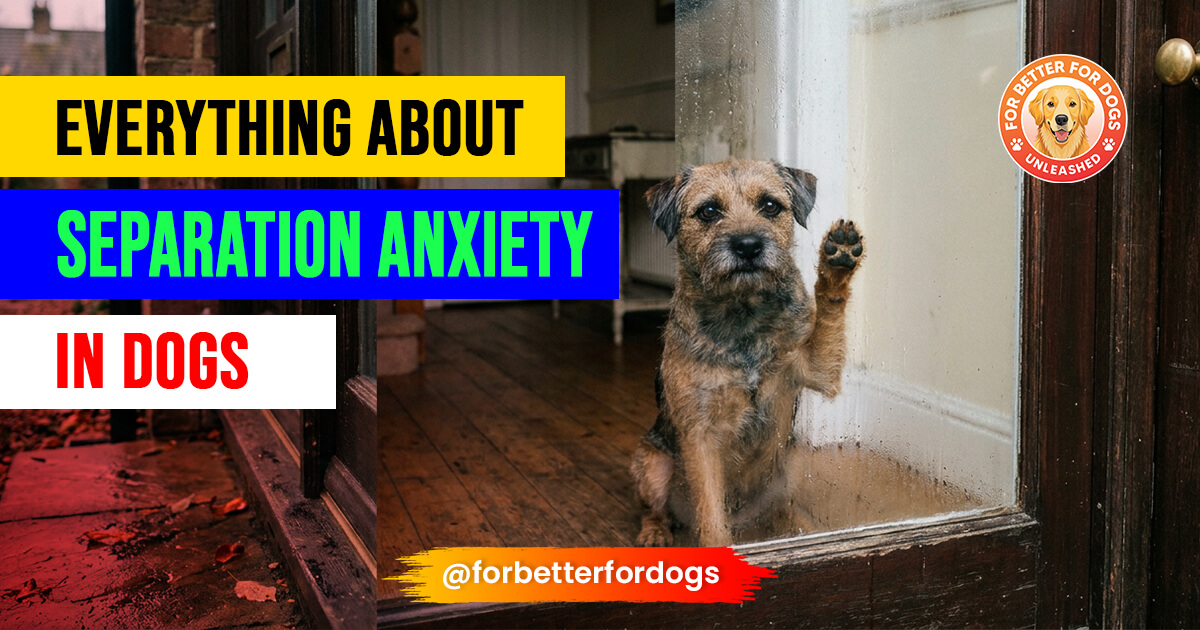
You leave the house… then somewhere behind that closed door, your dog falls apart.
Maybe you know because a neighbor has mentioned the barking. Maybe you came home to a destroyed sofa cushion or a puddle on the floor from a dog who is otherwise perfectly house-trained. Maybe you set up a camera and watched the footage and felt that specific kind of heartbreak that comes from seeing your dog pace, whine, and scratch at the door for the entire two hours you were gone.
Separation anxiety in dogs is the most distressing things your furry friend can experience, and it’s also one of the most exhausting things you as owner can navigate — because it does not just affect your dog when you are away. It affects every goodbye.. every morning routine… every time you need to leave the house for any reason at all.
Here is what most owners get wrong: they treat it as a behavior problem to be corrected. It is not. It is an emotional regulation problem — a dog who has not learned how to cope with being alone, genuinely struggling with something that feels to them like a genuine threat. Shouting at it, punishing it, or just hoping the dog will eventually settle down on their own does not work. And it never will, because you are addressing the symptom instead of the source.
This guide will walk you through what separation anxiety actually is in dogs, what causes it, how to recognize it, and — most importantly — what actually works to help your dog through it. Not quick fixes. Not internet hacks. The real approach, built on behavioral science and the kind of patience that genuinely changes things.
Table of Contents
What Separation Anxiety in Dogs Actually Is
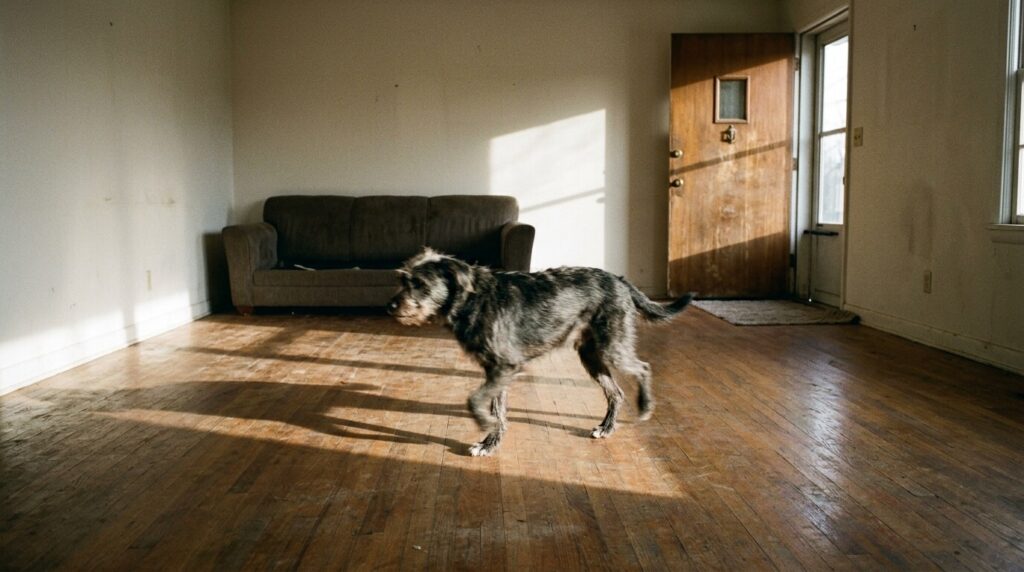
Separation anxiety — formally called separation-related distress — occurs when a dog cannot cope with being separated from the person or animal they are most attached to. That inability to cope is not stubbornness. It is not spite. It is genuine distress, driven by the same neurological systems that govern fear and panic responses in all social mammals.
Dogs are, at their core, a social species. They evolved alongside humans across tens of thousands of years of close partnership, and that evolutionary history wired them for connection. Being left alone triggers, for many dogs, the same physiological response that isolation triggers in any highly social animal: elevated cortisol, activated stress response, and behavior that reflects genuine emotional dysregulation — not misbehavior.
Dr. Kate Mornement, a Certified Applied Animal Behaviorist with a PhD in companion animal behavior, describes it this way: the ability to cope with separation from attachment figures is a learned behavior and a skill. We have to teach it. Dogs are not born knowing how to be alone, any more than a toddler is born knowing how to self-soothe. The difference is that with children, we recognize that teaching is our responsibility. With dogs, we often expect the skill to just be there — and then respond with frustration when it isn’t.
Understanding that separation anxiety is a learned skill deficit, not a character flaw, changes everything about how you approach it.

How Common Is Separation Anxiety in Dogs — Really?
More common than most owners realize — and more severe than the statistics usually convey.
Estimates vary, but research consistently places separation anxiety among the most prevalent behavioral problems in pet dogs. A frequently cited figure suggests that approximately one in four dogs will experience separation anxiety at some point in their lives. But a 2024 study by Beaver found something more striking: up to 85.9% of dogs displayed moderate to serious separation-related behaviors when left alone.
That number deserves a moment of attention. Not mild signs. Moderate to serious. In the overwhelming majority of dogs studied.
What this tells us is not that most dogs have a clinical disorder — it tells us that most dogs have not been adequately taught how to cope with being alone. The behavior is common because the teaching rarely happens. We bring dogs into our homes, spend enormous amounts of time with them, create deep attachment, and then one day simply leave — expecting that to go smoothly — without ever having prepared them for it.
This is not about blame. Most owners have no idea this preparation is their responsibility. But once you know it, you cannot unknow it. And knowing it is the first step toward actually helping your dog.

How to Recognize Separation Anxiety in Your Dogs.
The challenge with separation anxiety is that the signs happen when you are not there to see them. By the time you notice the chewed furniture, the complaints from neighbors, or the anxiety your dog seems to carry even before you leave, the problem is often already well established.
A camera — even a basic one — is genuinely one of the most useful tools for diagnosing separation anxiety. Watching your dog’s behavior in the first 30 minutes after you leave tells you more than any description can. What you are looking for is not just whether they settle, but how quickly, and what happens in between.
The signs of separation anxiety range from subtle to severe. In mild cases they are easy to miss. In moderate to severe cases they are impossible to ignore — for the neighbors if not for you.
Physical signs include panting without physical exertion, drooling, sweaty paw prints on hard floors, trembling, and a noticeably elevated heart rate that you can sometimes feel when you return and your dog is still in an aroused state.
Behavioral signs include excessive barking or whining that starts shortly after you leave and continues rather than fading, pacing between rooms or along walls, not eating food or treats left out when alone (a dog in genuine distress cannot access their appetitive behavior — the food being ignored is diagnostically significant), destructive scratching or chewing concentrated around exits like doors and windows, and house soiling from a dog who is otherwise reliably toilet trained.
Escape behavior — actively attempting to get out of the house or yard — sits at the severe end of the spectrum and carries genuine safety risks. Dogs have injured themselves badly attempting to escape through glass, over fences, or by chewing through drywall.
One important clarification: not all of these behaviors are automatically separation anxiety. Excessive barking can reflect boredom or insufficient mental stimulation. Destructive chewing in a young dog might be teething or frustration, not distress. A vet appointment to confirm the diagnosis and rule out underlying medical causes is always the right first step before you build a training plan.
What Triggers Separation Anxiety in Dogs.
Separation anxiety does not appear randomly. It is almost always traceable to a specific disruption — a change in routine, attachment, or environment that the dog did not have the coping skills to navigate.
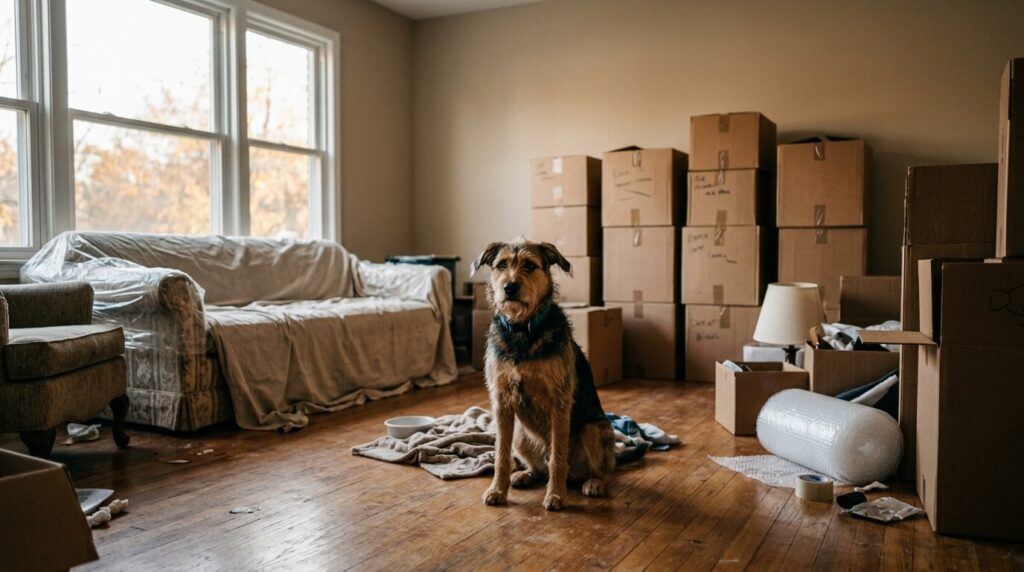
Common triggers include being brought to a new home as a puppy and experiencing separation for the first time, being surrendered to a shelter and then re-homed (the disruption to attachment is significant and often underestimated), moving house, a change in the owner’s work schedule that suddenly means much longer periods alone, a family member moving out, the death of a person or animal companion, a first experience at a boarding kennel, or even the owner returning to office work after a period of working from home.
That last one became dramatically more common after 2020. Dogs that had spent years with owners working from home suddenly found themselves alone for eight or nine hours a day with no preparation. Veterinary behaviorists reported significant increases in separation anxiety presentations in the years that followed.
The common thread running through all of these triggers is the same: a change happened, the dog lacked the pre-existing coping skills to manage it, and the anxiety filled the gap. Which means the intervention is not primarily about addressing the trigger — it is about building the skill that was always missing.

Why There Are No Quick Fixes — And What to Do Instead
Most owners searching for help with separation anxiety want to know how to fix it fast. That is completely understandable. Watching your dog suffer is painful. Coming home to destruction is stressful. The social pressure from neighbors about the barking is exhausting.
But there are no quick fixes for separation anxiety. Not in the way most people hope.
The internet is full of products, sprays, supplements, and training hacks that promise rapid results. Some of them are useful as supporting tools. None of them resolve the underlying issue on their own. Because the underlying issue is not a lack of lavender-scented spray. It is a dog who has not learned that being alone is survivable — and that skill takes time and consistent repetition to build.
The good news is that it can be built. Dogs are remarkably capable learners when the conditions for learning are right. The behavioral science behind treating separation anxiety is solid, and when applied consistently, it works. It just requires understanding that you are not training your dog to stop misbehaving — you are teaching them an emotional regulation skill they never had.
The Step-by-Step Approach That Actually Works
Start With a Vet Appointment
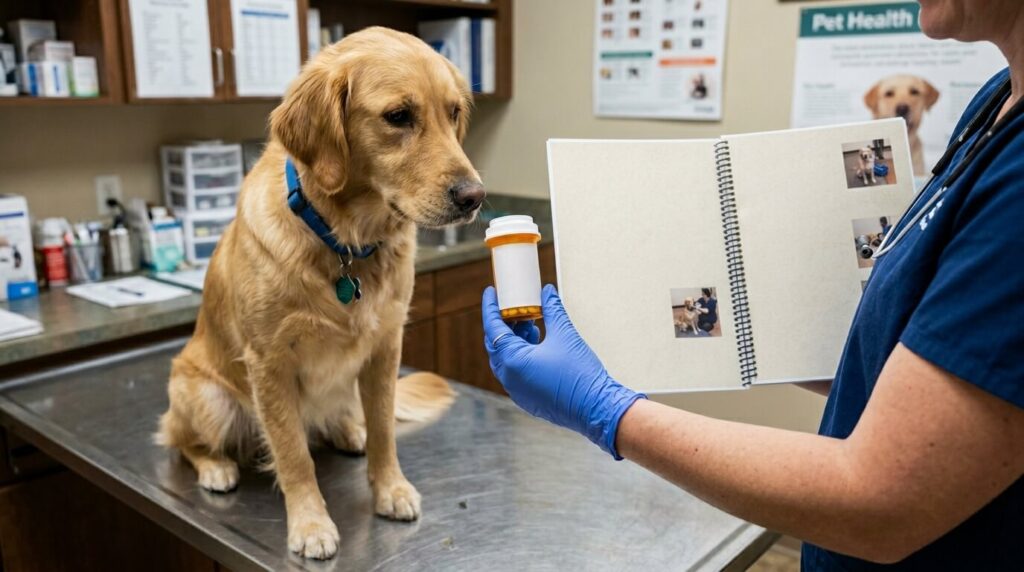
This is not optional. Your vet needs to confirm the diagnosis, rule out any medical contributors, and assess severity. They will also determine whether medication is appropriate — and for moderate to severe cases, the research is clear that medication significantly improves treatment outcomes by reducing anxiety enough to allow genuine learning to occur. We will come back to this.
If your vet recommends a veterinary behaviorist, take that recommendation seriously. The American College of Veterinary Behaviorists maintains a directory of board-certified veterinary behaviorists — these are specialists with advanced training specifically in behavioral disorders, and for severe cases they are the gold standard of care.
Short-Term Management Techniques
While you are building the long-term training plan, the immediate priority is stopping the cycle of repeated negative experiences. Every time your dog goes through a full panic episode alone, it reinforces the association between being alone and genuine distress. You need to break that cycle while you teach the new one.
- Avoid leaving your dog alone beyond their current threshold. This might mean dog sitters, doggy daycare, working from a location where your dog can come, or asking a friend or family member to cover gaps. This is not a permanent arrangement — it is a short-term management strategy while you do the work. Find reputable daycare options through the Pet Professional Guild
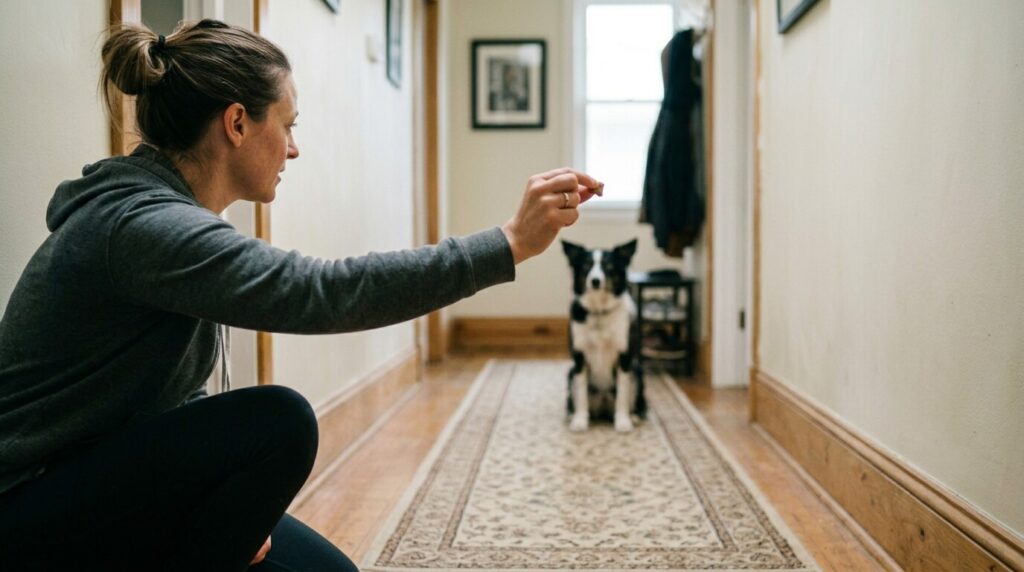
- Start teaching separation tolerance within your home. The goal here is to help your dog understand that being separated from you — even by a closed door, even in a different room — is not a threat. Begin with sit-stay exercises: ask your dog to sit, say “stay,” take one step away, wait three seconds, return to them. If they held the stay, mark it clearly with a “yes” or a clicker and reward immediately with a genuinely high-value treat — not kibble, something they are actually excited about. Repeat this multiple times. When they are succeeding consistently, increase the distance by one step, then two, then move toward a doorway, then out of sight for five seconds, then ten, building gradually. If your dog breaks the stay at any point, you have moved too fast. Return to the last distance they succeeded at and rebuild from there. Practice across different rooms and different times of day.
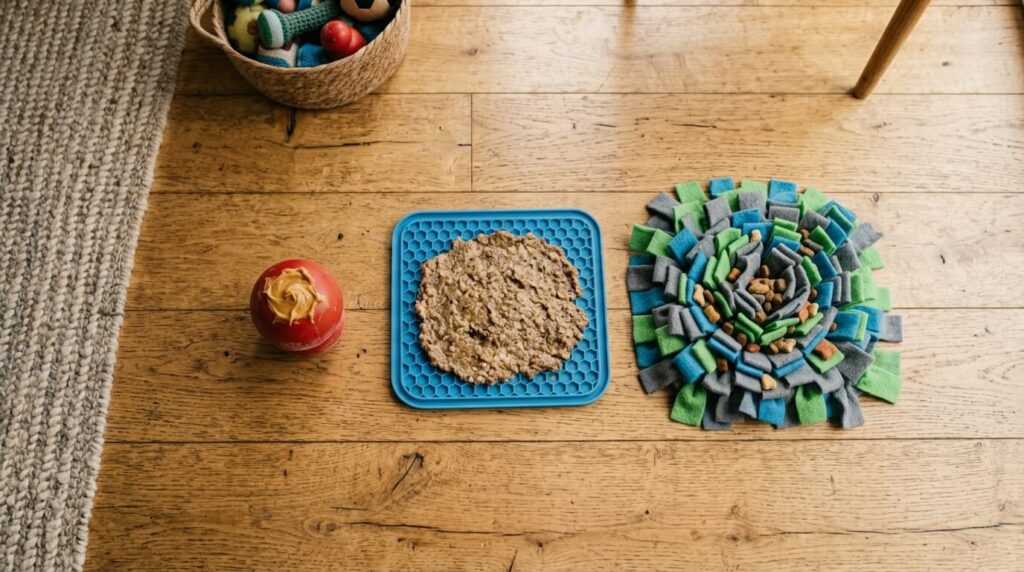
- Use meals and enrichment to build positive associations with separation. Feed your dog their meals in a separate room from where you are. Give them a stuffed Kong, a lick mat, or a sniff puzzle in a different part of the house from where you are sitting. What you are doing is repeatedly connecting “not being with you” to “something good is happening.” Over time and with enough repetitions, that association becomes genuinely internalized. The Kong Company’s range of fillable toys are widely used and veterinary-recommended for exactly this purpose.
Long-Term Training for Lasting Change
The core long-term approach is gradual desensitization combined with counter-conditioning — two terms that sound clinical but describe something straightforward.
Desensitization means exposing your dog to the trigger (being alone) at a level so mild it does not produce anxiety, and then very gradually increasing that level over time. Counter-conditioning means pairing that exposure with something positive, so the emotional association shifts from “being alone equals threat” to “being alone equals good things happen.”
In practice, this looks like this:
Leave the house for one to two minutes — a duration short enough that your dog does not pass into genuine anxiety — immediately before you leave, give them something high-value and long-lasting: a stuffed frozen Kong, a bully stick, a lick mat loaded with something they love. Return before they finish it. Do this multiple times a day. When they are consistently calm for one to two minutes, extend to three minutes. Then five. Then ten. The progression is slow and non-linear — you will have good days and setbacks — but the cumulative effect over weeks is real and measurable.
One specific technique that Dr. Mornement and other behavioral specialists emphasize: do not always increase the duration. Mix shorter departures in between longer ones. If your dog spends six days successfully managing fifteen-minute departures, do not automatically go to twenty on day seven. Go back to five, then ten, then fifteen, then try eighteen. Irregular, unpredictable departure lengths prevent your dog from building anticipatory anxiety about what is coming next.
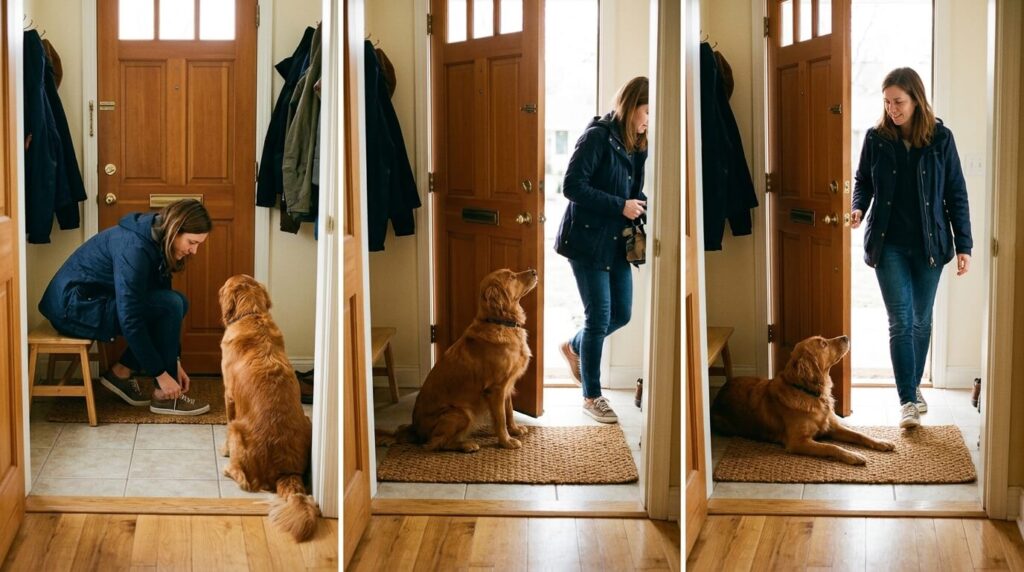
Change how you frame departures and arrivals. The goodbye ritual — the baby talk, the long cuddles, the emotional farewell — communicates to your dog that something significant is happening. It is not comforting them. It is priming their nervous system for the absence they are about to experience. A calm, matter-of-fact goodbye — treat on the mat, out the door, done — is genuinely kinder. The same applies to arrivals. Keeping your greeting low-key when you return, waiting until your dog has settled before giving them attention, teaches them that your comings and goings are routine events, not emotional peaks and valleys.
This is hard for most owners. It feels cold. It does not feel like love. But a dog whose nervous system is regulated, who has learned that you leave and you always come back and nothing terrible happens in between — that dog is experiencing something much closer to happiness than the dog who is highly stimulated by emotional goodbyes and then collapses into distress the moment the door closes.
When Medication Is Part of the Answer
This section matters and does not get the attention it deserves.
For dogs with moderate to severe separation anxiety, behavioral modification alone is often not sufficient — not because the training does not work, but because a dog in a state of genuine panic cannot learn effectively. Fear and severe anxiety actively interfere with the neurological processes required for new learning. It is not that the dog is being resistant. It is that their nervous system, in that state, is physiologically incapable of retaining new associations.
Medication — typically SSRIs or tricyclic antidepressants prescribed by your vet or veterinary behaviorist — reduces the anxiety to a level where the dog can actually engage with and benefit from the behavioral training. It is not a permanent solution and it is not a replacement for training. It is a facilitator that makes the training possible.
According to the American Veterinary Medical Association, anxiety medications in dogs are most effective when used in combination with behavioral modification — not as a standalone treatment. Your vet is the right person to assess whether your dog’s severity warrants this conversation. Do not dismiss it if they raise it. For the right dog in the right situation, it makes the difference between a training plan that works and one that does not.
The AVMA publishes guidance on behavioral pharmacology for dogs.

Teaching Your Dog the Skill They Were Never Given
Here is the honest perspective to carry away from all of this.
Separation anxiety is not your dog’s fault. It is not your fault either — most owners have no idea that coping with solitude is a teachable skill that their dog needed to learn, ideally from puppyhood. We do not talk about this enough. We celebrate bonding and attachment, as we should, but we rarely tell new dog owners that the flip side of a deeply attached dog is a dog who needs to be gradually taught that the attachment is not threatened by temporary separation.
If you have a dog struggling right now, the path forward is not dramatic. It is patient, consistent, incremental work — tiny steps repeated many times, enrichment tools used thoughtfully, departures and arrivals handled with calm matter-of-factness, and professional guidance when the severity warrants it. None of it is quick. All of it is possible.
Your dog is not suffering because they are broken. They are suffering because they love you and they have not yet learned that loving you does not require being with you every moment of every day. That lesson — calm, consistent, positive — is yours to teach them.
And when they learn it, the freedom it gives both of you is genuinely worth every step of the work.
At For Better For Dogs, we know separation anxiety is one of the hardest things to navigate — emotionally and practically. If you are in the middle of it right now, drop a comment below. Tell us where you are in the process, what you have tried, what is working. This community has more collective knowledge than you might expect — and we read every single comment.